

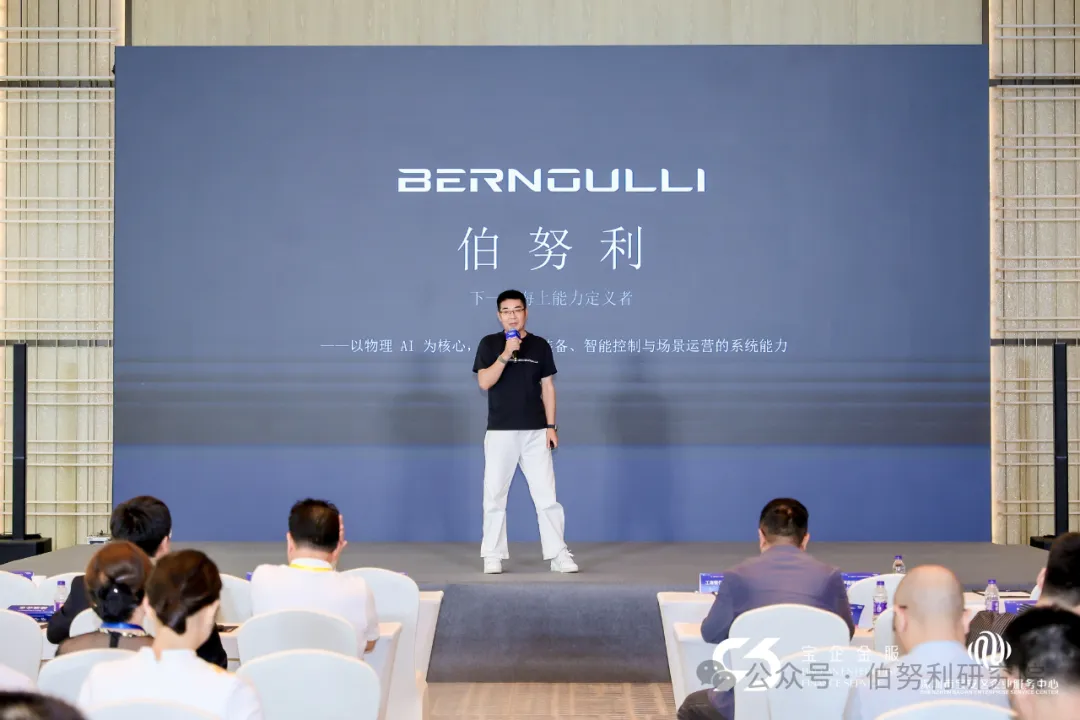
ifeng Shenzhen recently conducted an exclusive interview with BERNOULLI founder Ma Zhanyu at the event venue. The report focuses on BERNOULLI's core positioning in ocean technology and intelligent shipping, and asks how physical AI, wind-assisted propulsion, and long-range unmanned platforms could reshape a new maritime productivity model.
In the interview, Ma lays out a strategic direction built around one digital base, one cross-generation hardware stack, and one global network, together with a commercial and financing pathway intended to scale into a much larger ecosystem.
Move experimentation upstream and strip out risk earlier
In public imagination, ocean technology is still closely tied to heavy industry: large hulls, steel structures, and physical trial-and-error. Ma's argument in the interview is that the future ocean will not remain purely physical. It will inevitably be reconstructed by algorithms and computing power.
That logic starts with BERNOULLI's technical foundation. Instead of accepting the long cycle of waterborne trial and error common in shipbuilding, the company is pushing toward a digital-native shipbuilding workflow. By running millions of extreme-condition tests inside the "Cangqiong" ocean world model, the team aims to move most engineering uncertainty into simulation before physical launch.
On top of that base, BERNOULLI is building a hardware portfolio that includes the BlueShift wind-assist system, the NavBrain vessel intelligence stack, and a broader family of long-range unmanned platforms.
Break the speed-versus-green tradeoff
Traditional shipping spent decades optimizing for scale in order to serve global bulk trade. But the same slow, massive system is poorly matched to the increasing demand for high-speed and high-certainty delivery in modern supply chains.
BERNOULLI's opening is not to reject conventional shipping altogether, but to target high-value gaps where speed and energy efficiency are usually treated as mutually exclusive. The interview points to a 60TEU high-speed vessel concept built around a hybrid architecture of methanol generation, lithium storage, and wind-assisted propulsion.
In that framing, the wing sail is not a symbolic sustainability accessory. It is intended to function as a real performance layer: efficient assist under cruise conditions, and more aggressive support when time sensitivity matters most.
The report also highlights BERNOULLI's aerospace engineering background. By bringing zero-tolerance risk logic and a flight-control-style dual-stack safety architecture into marine systems, the company is effectively trying to redefine what stability and safety redundancy should mean at sea.
Sell time, not tonnage
The interview argues that hardware sales alone cannot define the next maritime ecosystem. That is where SEA, BERNOULLI's global maritime express platform concept, enters the story.
On SEA, the product is no longer traditional capacity measured in tonnage. The offer is time certainty. The stated ambition is for maritime transport to become time-structured in a way that feels closer to high-speed rail or aviation.
Commercially, the company describes a repeatable system of home ports, fast routes, and digital dispatch. The initial loop is positioned around the Greater Bay Area, with later replication across the Yangtze River Delta, broader Chinese coastal corridors, and eventually selected international nodes in the Middle East and Europe.
Data flywheel and ecosystem-scale ambition
Ma is explicit in the interview that hardware specifications alone are not a durable moat. Over time, they can be matched. BERNOULLI's stronger long-term defense is described as a three-part structure: foundational compute, a commercial network, and a data flywheel.
As routes expand, every vessel becomes a sensing node. Real-world operating data from complex sea states can flow back into the digital twin system, allowing the algorithm layer to improve continuously rather than only through isolated engineering iterations.
The operating split is also made clear. BERNOULLI holds the role of a physical AI engine, while SEA is meant to evolve into a lighter and broader time-sensitive maritime infrastructure platform.
On the capital side, the company says it is looking for investors who understand both deep-technology platforms and logistics network effects. On the industrial side, it wants closer alliances with core ports and major demand-side partners whose fulfillment needs are highly time-sensitive.
In the end, the report frames BERNOULLI's ambition as larger than a new vessel class or a faster route. The deeper claim is that once physical AI and high-speed maritime networks mature together, they could help redefine both commercial order and the technological foundation of the ocean economy.